CoDEx 2026 - The Best of the Best
We are pleased to announce the winners of the CoDEx 2026 Poster Session, Visualization Challenge, and People's Choice Award. Thank you to all the participants, and congratulations to the award recipients!
Twenty posters were presented; however, only undergraduate and graduate students were eligible for the awards. We are pleased to announce the recipients of the CoDEx 2026 Poster Session.
Poster Winners
First Place
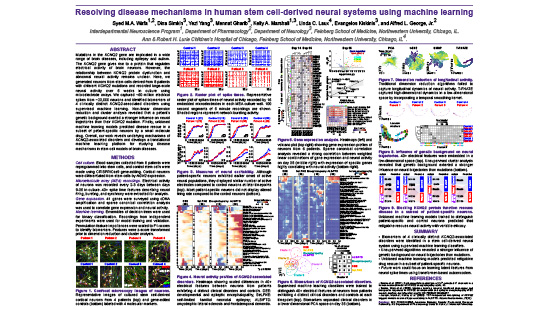
Resolving time-dependent phenotypes of stem cell-derived neurons harboring KCNQ2 mutations using machine learning
Syed Wafa, PhD Student, Feinberg School of Medicine, et al.
We perform large-scale electrical recordings from human stem cell-derived neurons harboring mutations in the KCNQ2 gene, which is implicated in severe brain disorders, including epilepsy and autism. By analyzing tens of millions of electrical spikes using supervised and unsupervised machine learning algorithms, we identify temporal biomarkers of clinically distinct KCNQ2-associated disorders. Our work establishes an open-source, publicly available translational machine learning platform for studying disease mechanisms and therapeutic responses in stem cell models of neurological disorders.
Second Place
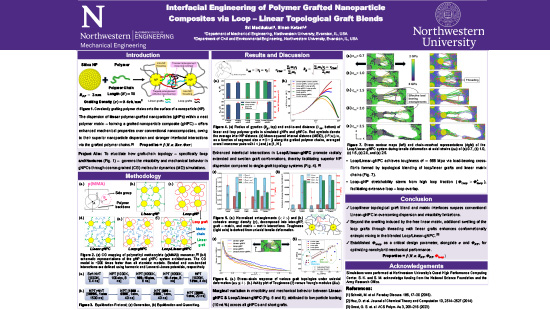
Interfacial Engineering of Polymer Grafted Nanoparticle Composites via Loop-Linear Topological Graft Blends
Sri Maddukuri, PhD Student, McCormick School of Engineering and Applied Science, et al.
This molecular research explores the use of loop-linear graft mixtures as a novel strategy for tailoring the interphases of polymer nanocomposites. Through computational and data-intensive conformational and entanglement analyses, this work provides a physical foundation for using the loop graft architectures to overcome dispersion challenges and enhance mechanical reinforcement through improved miscibility.
Awards
Poster presentations were evaluated based on poster content and in-person presentation. Thank you to our dedicated judges.
- First Place: Conference fees, travel, and related expenses, up to $3,000, to attend a research-related conference within 12 months of CoDEx 2026.
- Second Place: $500 Visa gift card
Thank you to our corporate sponsors for making the awards possible.
Eleven visualizations submitted by graduate and undergraduate students at Northwestern were eligible to enter the CoDEx 2026 Visualization Challenge and receive an award. Thank you to all the participants.
Awards were given for static visualizations (e.g., charts/graphs, illustrations, photographs, infographics, etc.). Congratulations to all!
Visualization Winners
First Place
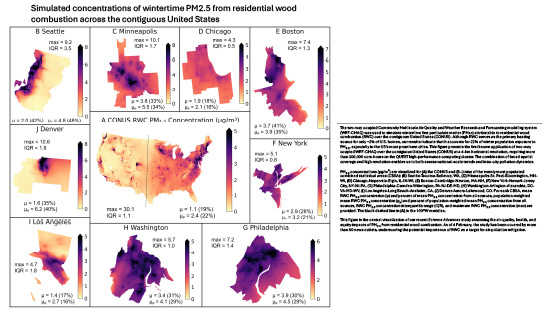
Ambient air quality and health impacts of PM2.5 from US residential wood combustion
Kyan Shlipak, Undergraduate Student, McCormick School of Engineering and Applied Science
Figure caption: The central visualization of our recent Science Advances study assessing the air-quality, health, and equity impacts of PM2.5 from residential wood combustion. As of 4 February, the study has been covered by more than 50 news outlets, underscoring the potential importance of RWC as a target for air-pollution mitigation.
Second Place
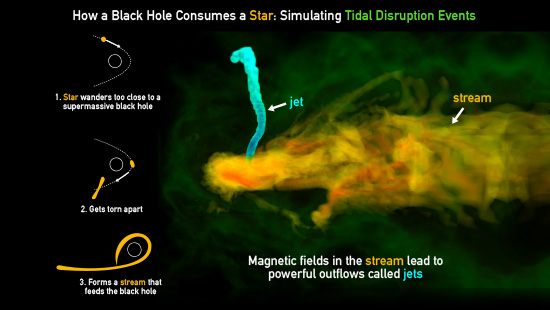
How a Black Hole Consumes a Star: Simulating Tidal Disruption Events
Pavani Jairam, PhD Student, Weinberg College of Arts and Sciences
Figure caption: When a star gets too close to a supermassive black hole, it gets torn apart by the black hole’s gravitational forces in what is known as a tidal disruption event (TDE). The star is pulled into a stream that wraps around the black hole and accretes on the timescale of weeks to months. This process is outlined by the schematic on the left, created in Keynote.
Awards
Visualizations were evaluated based on presentation clarity and aesthetics, visualization method used, and accessibility. Thank you to our dedicated judges.
- First place: $500 Visa gift card
- Second place: $250 Visa gift card
Thank you to our corporate sponsors for making the awards possible.
The People’s Choice Award allows attendees of CoDEx to vote for their favorite Poster Competition and Visualization Challenge entry. This special award provided an opportunity for attendees to engage with the researchers presenting at CoDEx and to voice their appreciation for their work.
Jackie Milhans, director, Research Computing and Data, presented the awards. Congratulations to the winners!
Poster Winner
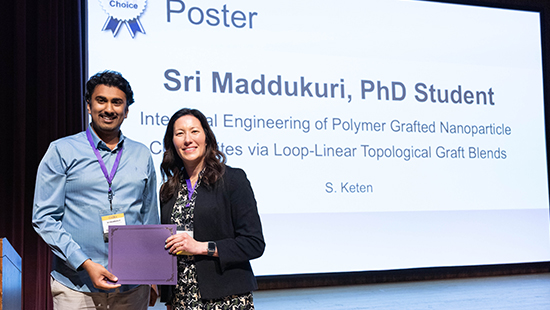
Interfacial Engineering of Polymer Grafted Nanoparticle Composites via Loop-Linear Topological Graft Blends
Sri Maddukuri, PhD Student, McCormick School of Engineering and Applied Science, et al.
Visualization Winner
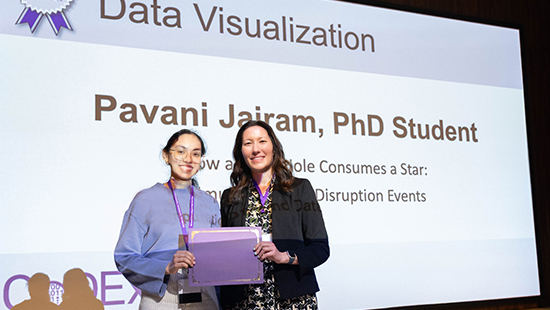
How a Black Hole Consumes a Star: Simulating Tidal Disruption Events
Pavani Jairam, PhD Student, Weinberg College of Arts and Sciences
Award
Award: $100 Visa gift card
Thank you to our corporate sponsors for making the awards possible.